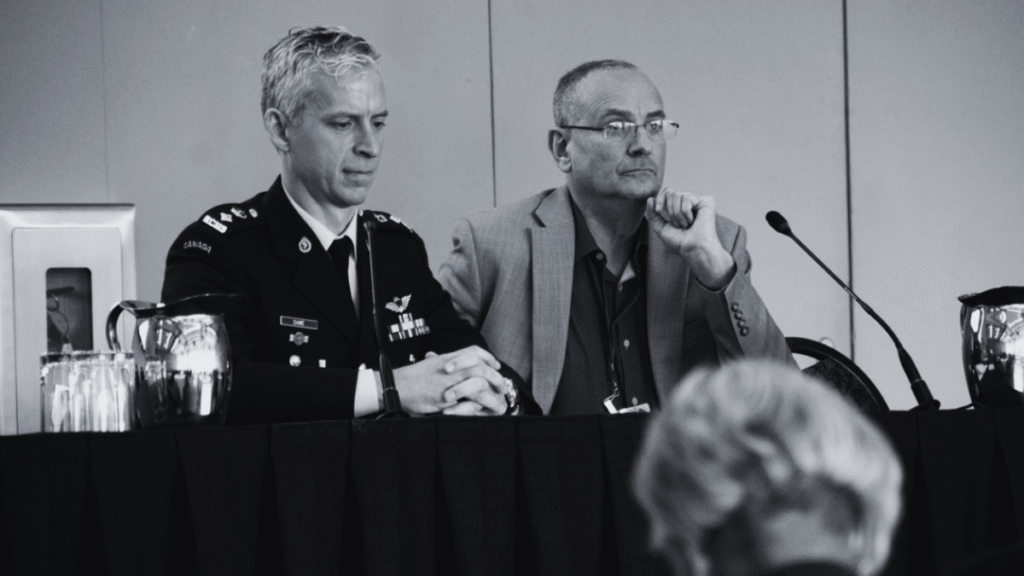
Dr. Martin A. Schreiber, a nationally recognized leader in trauma resuscitation and military civilian trauma collaboration, took the stage at the North Pacific Surgical Association annual meeting at the Banff Centre in November 2025. This Dr. Martin Schreiber NPSA 2025 keynote, officially titled “Large Scale Combat Operation: Are We Ready”, was delivered to more than 150 trauma surgeons from across Oregon, Washington, Idaho, British Columbia, and Alberta.
Within his first sentence, he commanded the entire room. His opening question shaped the atmosphere:
“Are we really ready for the next war”
There was no small talk. He did not mention his credentials up front. He created tension and urgency, which are the first essential ingredients for any impactful high stakes presentation. Below are the precise strategies he used, illustrating how Martin Schreiber trauma surgeon expertise translates directly into communication mastery for any professional audience.
Start with a grenade, not a greeting
Most presenters begin by warming up the audience. Colonel Martin Schreiber began by describing real combat medical scenarios. He showed how assumptions about fast evacuation and abundant supplies collapse instantly during large scale combat operations. He grounded the stakes in lived reality from Iraq and Afghanistan where survival depended on immediate bleeding control and whole blood availability.
This is the first lesson for commanding a room. Introduce the problem before the audience has time to relax.
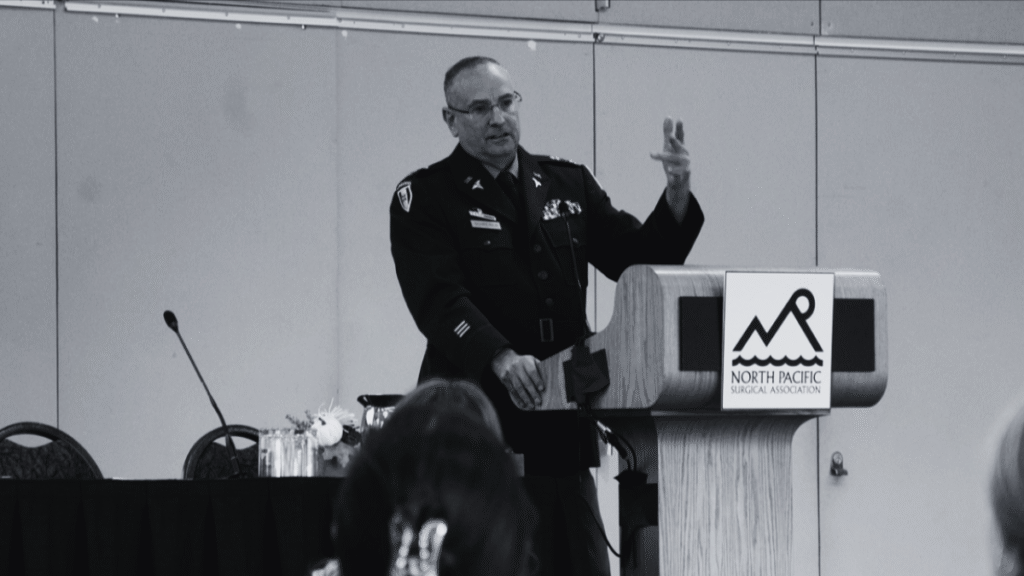
Use rank without saying rank
Dr. Martin A. Schreiber MD never opened with military hierarchy. His experience spoke for itself. He shared precise details about injuries, rapid decision making under fire and the shift from component blood back to whole blood in battlefield trauma. These kinds of specifics signal credibility far more effectively than announcing titles.
His authority came from content, not from a slide listing achievements. That is how Dr. Martin Schreiber military medicine expertise holds attention.
Make the audience the hero
The Martin Schreiber Banff keynote 2025 pivoted at the halfway point from battlefield medicine to battlefield to civilian ER innovations. He told the audience:
“Every lesson we learned in combat exists in your trauma bay. You only need to decide to use them”
This single statement transferred responsibility to the audience. They were the ones with the power to change outcomes in civilian hospitals. This approach made every trauma surgeon in the room the protagonist of the story.
If you want buy in, put the power in the audience seat, not on the stage.
Use silence as a tool
Dr. Schreiber presented data showing that whole blood transfusion trauma surgeon driven protocols lowered mortality by up to half in severe trauma. Then he stopped speaking. He turned off the screen. He waited.
The silence hit harder than the statistics. It forced reflection. It made the audience feel the weight of trauma readiness 2025 rather than merely hearing about it.
Silence is not empty. It is an amplifier.
End with a question they are not yet ready to answer
Many presentations end with a thank you slide. This one did not.
Dr. Schreiber concluded with the question now associated with his leadership on future war trauma preparedness:
“We built the best trauma system in the world for the last war. Who is building the best trauma system for the next one”
He then walked away. No applause line. No QR code. Just urgency.
Ending on a question holds the audience accountable for what comes next.
The message behind the presentation
While the focus here is communication excellence, the content of Colonel Schreiber trauma research 2025 matters enormously.
He warned that future conflicts may include:
• Delayed evacuation
• Limited communication
• Shortages of blood products
• Mass surges in casualties
In that environment, civilian hospitals would be the primary response network. He called for coordinated planning between military and civilian trauma systems, national access to whole blood, stronger partnerships with rural hospitals and more realistic training in austere care.
This message fits directly into his ongoing Dr. Martin Schreiber current role in national trauma readiness efforts.
Progress does not guarantee preparedness. Readiness must be deliberate.
Why Dr. Martin A. Schreiber MD was the right person to deliver this challenge
Dr. Schreiber has shaped trauma care on both the battlefield and in academic medicine.
Highlights of his background:
• Colonel in the United States Army Reserve
• Adjunct Professor of Surgery at Martin Schreiber Uniformed Services University
• Former Chief of Trauma, Critical Care and Acute Surgery at Oregon Health & Science University
• More than 450 scientific publications on life saving trauma care
His career embodies the collaboration he calls for. He has personally built systems that help translate war zone advances into civilian trauma bays.
That credibility is why the Dr. Martin Schreiber North Pacific Surgical Association audience listened without shifting in their seats.
The communication blueprint any expert can steal
To control a room the way Dr. Schreiber did, you must create contrast.
Tension and relief
Fact and silence
Expertise and humility
Risk and responsibility
Questioning and action
Do those well and the room does not simply listen.
It leans in.
It follows.
The Martin Schreiber trauma surgeon 2025 keynote in Banff showed that communication is a leadership skill. The goal is not applause. The goal is transformation.
Dr. Martin A. Schreiber left surgeons with a mission. Not a message. Not a conclusion.
A mission.